

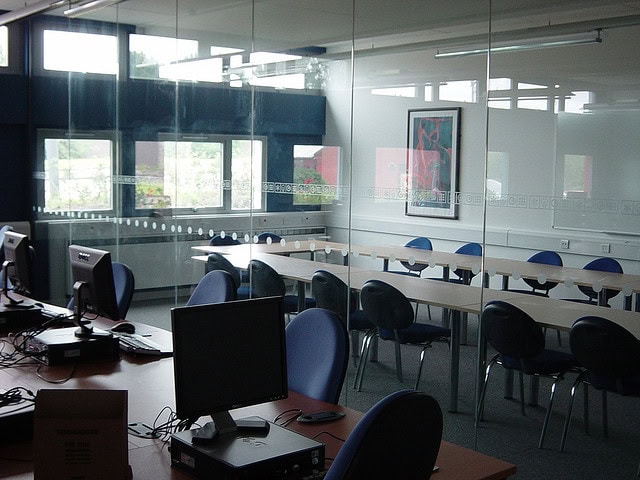
The design of educational facilities should contribute to enhancing the teaching environment and supporting meaningful academic and social student interactions. Who wouldn’t prefer to spend their work or school time in a clean, vibrant, properly designed and natural light-infused space?
Designers of educational spaces today are charged with creating healthy, productive and stimulating environments. Here are four major trends in interior design for higher education.
1. Sustainable Design
Research shows a link between sustainable facilities and more effective learning environments, so it’s not a surprise the education sector is one of the fastest growing markets for sustainable design and LEED certification.
Indoor Air Quality: Studies have shown that air quality may impact a person’s learning performance by as much as 10 to 20%, so it’s important to specify low VOC furnishings and interior materials that will contribute to improved indoor air quality.
Lighting: It has been proven that daylighting improves morale and reduces absenteeism. Taking full advantage of exposure to natural light in your space planning will also reduce energy costs as well as fulfill the natural desire for sunlight.
Environmental Practices: Green thinking is becoming part of our everyday consciousness, especially with today’s college students. In fact, studies show that sustainability is beginning to impact high-school student’s choices when selecting a college. Recycling and re-using, therefore, becomes an education in itself. Refurbishing and repurposing existing furniture when possible will extend their useful life and keep them out landfills. Specifying new furnishings and finish materials that use recycled materials in their manufacturing will have a larger impact on reducing waste.
2. Technology Integration
Keeping pace with the latest technology is a critical component in the design of learning environments. Creating spaces for students to enhance their learning experience with technology is more important than ever. Because today’s “Millennials” are tech-savvy multi-taskers who constantly expect access to the internet, wireless connectivity rules the day. Learning is happening everywhere, so all spaces should have comfortable furniture and plenty of electrical outlets throughout.
The classroom is reaping the benefits of technology too, with evermore advanced podiums and multiple screens with sophisticated presentation software that speak to a generation who expect constant stimulation.
3. Classroom Flexibility
Classroom furniture of yesterday consisted of fixed rows of desks with a chalk board on the head wall. New and renovated classrooms have flexible and user-centered fixtures and furnishings, such as easily movable furniture that answers to the teaching styles of each professor with the ability to reconfigure quickly and quietly with minimal distraction. Increasingly, universities want flexible spaces that can have multiple uses over their lifetimes.
4. Collaborative Areas
Current pedagogical methods at the college level emphasize problem-based learning and collaboration among students over the traditional lecture format. As students move from just receiving information to discussing and experiencing it, engagement increases and and peaks when students in turn convey the information to others. Well-designed interiors provide plenty of opportunity for interaction and collaboration.