

Considered a “total” art style, embracing architecture, interior design, graphic art, and most of the decorative arts, Art Nouveau was a reaction to the academic art and revival styles of the 19th century. Art Nouveau (the “new art”) was a widely influential, relatively short-lived movement that was popular from about 1890–1910. Although it was quickly replaced by Art Deco, Art Nouveau is now seen as an important predecessor of modernism.
The advent of Art Nouveau can be traced to two distinct influences: the introduction, around 1880, of the Arts and Crafts movement, led by the English designer William Morris and Japonisme that was popular in Europe, particularly Japanese wood-block prints that contained rhythmic floral patterns and “whiplash” curves, all key elements of what would eventually become Art Nouveau.
The practitioners of Art Nouveau sought to revive good workmanship and produce genuinely modern design. But unlike the Arts and Crafts Movement, Art Nouveau did not eschew the use of machines. Artists of this movement desired to combine the fine arts and applied arts, even for utilitarian objects.
The movement issued in a wide variety of styles, and, consequently, it is known by various names, such as the Glasgow Style, and in Germany, as Jugendstil. It is also known as as Modern in Russia, as Modernisme in Spain, as Secession in Austria-Hungary and as Stile Liberty in Italy. Although Art Nouveau acquired distinctly localized characteristics, some general features, such as organic, flowing lines resembling the stems and blossoms of plants, as well as geometric shapes, are indicative of the form.
Architecture
In architecture, hyperbolas and parabolas in windows, arches, and doors are common, and decorative mouldings evolve into plant-derived forms. The Museum of Applied Arts in Budapest and the Secession Building in Vienna, are prime examples of Art Nouveau’s decorative and symmetrical architectural aesthetic.
[slideshow_deploy id=’1815′]
Glass art
The Art Nouveau movement found tremendous expression in glass art. Well known examples Examples include the lamps and favrile glass of Louis Comfort Tiffany in New York, and marquetry cameo glass by both Émile Gallé and the Daum brothers in Nancy, France. René Lalique started to produce early works in glass which were a precursor to his work in the Art Deco style.
[slideshow_deploy id=’1822′]
Fine Art and Graphics
Art Nouveau was the first major artistic stylistic movement in which mass-produced graphics played a key role. A key influence was the Paris-based Czech artist Alphonse Mucha, whose advertisement for a play featuring Sarah Bernhardt popularized the new artistic style. Other Art Nouveau artists include Henri de Toulouse-Lautrec, Aubrey Beardsley, Jan Toorop and Gustav Klimt.
[slideshow_deploy id=’1830′]
Ceramics
Clay was the perfect medium for the Art Nouveau aesthetic. It was a period where lost techniques were rediscovered and entirely new methods were developed, especially with glazes and firing techniques. Art Nouveau pottery produced by major factories, as opposed to individual artists, tended to emphasize surface decoration over experimental glazes. These pieces were adorned with imagery inspired by Viennese Secessionists and Jugendstil artists as well as Japanese art, including blooming plants, exotic birds like peacocks, and the popular femme-fleur, or flower woman.
[slideshow_deploy id=’1838′]
Jewelry
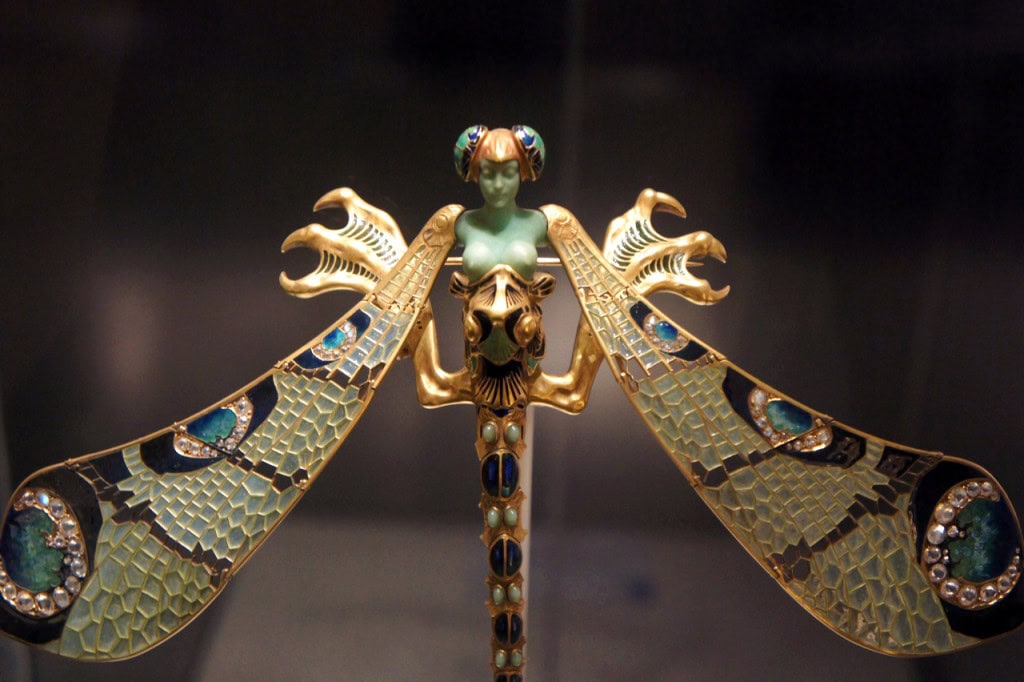
With Art Nouveau, a new type of jewelry emerged, motivated by the artist-designer with nature as the principal source of inspiration, complemented the introduction of new materials, such as opals and semi-precious stones. Enthusiasm for Japanese metalworking skills fostered new themes and approaches to ornament. French designer-jeweler-glassmaker René Lalique was most influential, glorifying nature and extending his repertoire to include new aspects of nature—such as dragonflies or grasses.
As quickly as Art Nouveau became popular in the late 19th century, artists, designers and architects abandoned it just as quickly in the first decade of the 20th century. Although Art Nouveau was replaced by 20th-century Modernist styles, it is now considered as an important transition between the eclectic historic revival styles of the 19th century and Modernism.
Photo Credits: Click images to view sources.
Click here to see more examples of Art Nouveau on our Pinterest board.
GIO brings you a carefully curated selection of tile and stone products developed expressly for your commercial design projects. Our looks cover a range of styles to transform commercial spaces. From retail and restaurants to hospitals and hospitality, we’ve assembled an assortment of collections in styles befitting the gamut of spaces you may be called to design. Turn to us for the latest solutions in architectural surfacing for your projects. We’re here to work with you!