

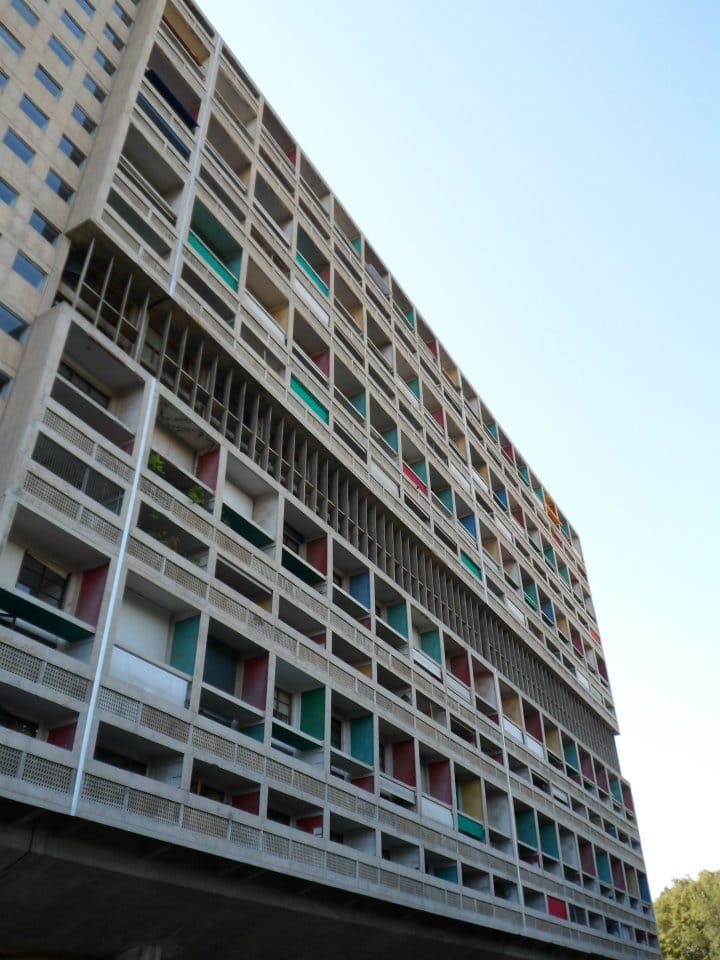
The Brutalist architectural movement flourished from the 1950s to the mid-1970s, and though it is sometimes classified as its own distinctive subtype, Brutalism is considered a variant of post-war modernism. The name is derived from the French word for “raw” in the phrase coined by Le Corbusier (while constructing his Unite d’Habitation in Marseille, France) to describe his choice of material, béton brut (raw concrete).
The Brutalist style is most associated with concrete, but it is meant to describe buildings of the 1950s through the early 1970s that showcase masonry materials in an honest way, reflecting back to history but with a modern interpretation. While the style shares with Modernism the fundamental principle promoted by Louis Sullivan and his successors, that “form forever follows function,” Brutalism was a reaction against early modernism which claimed to honestly express materiality, but was in fact covering each building with plaster and paint.
Brutalism rose to popularity in the 1950s and mostly fell out of favor in the last few decades, though there were sporadic resurgences in South America and the Middle East. The style is controversial, with critics finding it unappealing due to its “cold” appearance and using words such as “hideous”,”inhuman”, and “monstrous” to describe the buildings. Many of the buildings suffered from urban decay due to neglect and materials weathering poorly in certain climates. By the 1980s and 90s the plan in many areas was to knock down the worst offenders.
Today, many people now see the beauty in brutalism. There are blogs, websites, and architectural tours devoted to a re-evaluation of the movement, and buildings once deemed monstrosities are now national treasures. Several Brutalist buildings have been granted historic status, and others have been the subject of conservation campaigns; fortunately, many examples of this fascinating architectural style have survived demolition.
Check out our Pinterest board to see many great examples of Brutalist architecture.
Gio brings you only the finest commercial grade products, hand-picked from global sources based on our focused knowledge of what you need to to transform commercial spaces. Contact us anytime – we’re here to work with you!